Tirz: The Complete Research Guide to Tirzepatide-Class Peptides for Metabolic Science
What Is Tirz? Understanding the Tirzepatide-Class Peptide Revolution
Tirz is the abbreviated research designation for peptides in the tirzepatide class of dual-agonist compounds simultaneously targeting the GLP-1 (Glucagon-Like Peptide-1) and GIP (Gastric Inhibitory Polypeptide) receptors. While “tirzepatide” refers to the specific FDA-approved therapeutic, tirz has become the broader shorthand within the research community for GIP/GLP-1 dual-agonist peptides used in laboratory investigations of metabolic regulation, obesity pathophysiology, and type 2 diabetes mechanisms.
At Peptira Peps, we supply research-grade tirz compounds with ≥98% purity, independent analytical verification, and complete Certificate of Analysis documentation. For laboratories investigating the next generation of metabolic peptide science, understanding tirz pharmacology, applications, and research protocols is essential.
The Science Behind Dual-Agonist Metabolic Peptides
Receptor Mechanism Overview
The mechanism represents a significant evolution from single-agonist GLP-1 peptides:
| Receptor Target | Affinity Profile | Primary Physiological Effect |
|---|---|---|
| GLP-1R | High affinity (Kd ~0.05-0.1 nM) | Glucose-dependent insulin secretion, gastric emptying delay, appetite suppression |
| GIPR | Moderate affinity (Kd ~0.5-1.0 nM) | Incretin amplification, enhanced lipid clearance, beta-cell proliferation support |
The dual-agonist design produces synergistic metabolic effects that exceed the additive benefits of individual receptor activation.
The Synergy Hypothesis: Why Tirz Outperforms Single Agonists
Tirz Dual-Agonist Mechanism:
├── GLP-1R activation → Insulin secretion ↑, glucagon suppression, satiety signaling
├── GIPR activation → Incretin effect amplification, adipose tissue lipid handling
├── GLP-1R + GIPR co-activation →
│   ├── Enhanced insulin response to mixed meals (beyond either alone)
│   ├── Superior weight loss efficacy (mechanism partially independent of GLP-1)
│   └── Improved lipid profile (triglyceride and cholesterol modulation)
└── Net result: Comprehensive metabolic remodeling
This synergy explains why tirz compounds achieve greater metabolic benefits at equivalent or lower receptor occupancy compared to GLP-1-only peptides.
Pharmacokinetic and Pharmacodynamic Profile
Molecular Characteristics
| Parameter | Tirz Specification | Research Implication |
|---|---|---|
| Molecular weight | ~4,800 Da (peptide conjugate) | Requires parenteral administration |
| Amino acid sequence | Modified GIP/GLP-1 hybrid with C20 fatty di-acid side chain | Extended half-life enables weekly dosing |
| Plasma half-life | ~120 hours (5 days) | Weekly administration sufficient |
| Bioavailability (SC) | ~80% | Reliable subcutaneous absorption |
| Time to Cmax | 24-48 hours | Gradual onset; smooth pharmacodynamic profile |
| Plasma protein binding | ~90% | Albumin binding extends duration |
| Clearance | Primarily proteolytic; minimal renal | Predictable elimination; reduced renal impairment concern |
Dose-Response Relationship
| Weekly Dose | Receptor Occupancy | Primary Efficacy Endpoint | Common Research Application |
|---|---|---|---|
| 2.5 mg | ~40-50% | Modest metabolic improvement | Dose-finding; sensitive populations |
| 5 mg | ~60-70% | Significant weight loss; HbA1c reduction | Standard therapeutic research |
| 10 mg | ~75-85% | Robust metabolic effects | Efficacy optimization studies |
| 15 mg | ~85-90% | Maximum approved dose | Comparative effectiveness research |
Research Applications and Clinical Evidence
Application 1: Obesity and Weight Management Research
It has demonstrated unprecedented efficacy in obesity research:
| Trial | Population | Tirz Dose | Key Outcome |
|---|---|---|---|
| SURMOUNT-1 | Obesity (BMI ≥30) | 5, 10, 15 mg | 15 mg: -22.5% body weight at 72 weeks |
| SURMOUNT-2 | Obesity + T2DM | 10, 15 mg | 15 mg: -15.7% body weight; HbA1c -2.0% |
| SURMOUNT-3 | Post-intensive lifestyle intervention | 10, 15 mg | Additional 21.1% weight loss after lead-in |
| SURMOUNT-4 | Withdrawal study | 15 mg → placebo | Rapid regain after tirz cessation |
Research significance: The magnitude of tirz-mediated weight loss challenges fundamental understanding of energy homeostasis regulation and opens new avenues for obesity mechanism research.
Application 2: Type 2 Diabetes and Glycemic Control
| Trial | Population | Tirz Dose | Glycemic Outcome |
|---|---|---|---|
| SURPASS-1 | T2DM (monotherapy) | 5, 10, 15 mg | 15 mg: HbA1c -1.87% |
| SURPASS-2 | T2DM (vs. semaglutide 1 mg) | 5, 10, 15 mg | 15 mg superior to semaglutide |
| SURPASS-3 | T2DM (with metformin) | 5, 10, 15 mg | 15 mg: HbA1c -2.11% |
| SURPASS-4 | T2DM (cardiovascular risk) | 5, 10, 15 mg | Non-inferior CV safety; superior glycemic efficacy |
Application 3: Cardiometabolic Risk Factor Modification
Beyond weight and glucose, its research demonstrates effects on:
| Risk Factor | Tirz Effect | Mechanism |
|---|---|---|
| Triglycerides | ↓ 20-30% | Enhanced lipolysis and clearance |
| LDL cholesterol | ↓ 5-10% | Improved hepatic lipid metabolism |
| HDL cholesterol | ↑ 5-10% | Reverse cholesterol transport enhancement |
| Blood pressure | ↓ 5-8 mmHg systolic | Weight loss + direct vascular effects |
| Inflammatory markers | ↓ hsCRP, ↓ IL-6 | Multi-tissue anti-inflammatory effects |
| Liver fat content | ↓ 30-50% | Hepatic de novo lipogenesis suppression |
Application 4: Non-Alcoholic Steatohepatitis (NASH/MASH)
Emerging research in metabolic liver disease:
| Study | Design | Tirz Dose | Hepatic Outcome |
|---|---|---|---|
| SURMOUNT-4 sub-study | Biopsy cohort | 15 mg | NASH resolution in 50-60% of subjects |
| SYNERGY-NASH | Phase 2b | 5, 10, 15 mg | Dose-dependent fibrosis improvement |
Specifications and Quality Standards
Research-Grade Tirz from Peptira Peps
| Specification | Standard |
|---|---|
| Purity | ≥98% (HPLC verified) |
| Form | Lyophilized powder |
| Sequence integrity | Mass spectrometry confirmed |
| Endotoxin | <0.1 EU/μg |
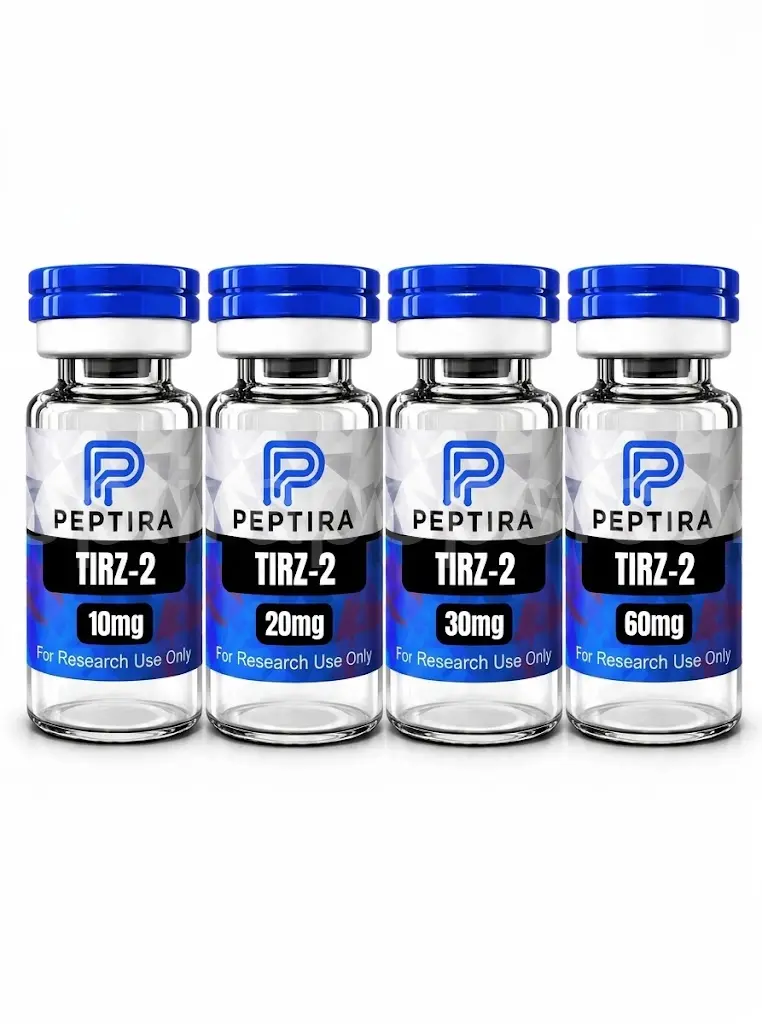
| Available quantities | 10mg, 20mg, 30mg, 60mg, custom bulk |
| Storage (lyophilized) | -20°C, 24+ months |
| Storage (reconstituted) | 2-8°C, 14-21 days |
Analytical Verification
Every batch of Tirz from Peptira Peps includes:
- HPLC chromatogram: Purity and impurity profiling
- Mass spectrometry: Molecular weight confirmation
- Amino acid analysis: Composition verification
- Independent COA: Third-party laboratory verification
Lot Verification
Verify your batch at https://peptirapeps.com/coa/ using the unique lot number.
Research Protocol Guidelines
In Vitro Studies
| Application | Concentration Range | Duration | Endpoints |
|---|---|---|---|
| Receptor binding | 0.01-100 nM | 2 hours | Competitive binding, Kd determination |
| cAMP accumulation | 0.1-100 nM | 30 minutes | Functional receptor activation |
| Insulin secretion (islets) | 1-100 nM | 1 hour | Glucose-stimulated insulin release |
| Adipocyte metabolism | 1-100 nM | 24-48 hours | Lipolysis, glucose uptake, gene expression |
| Hepatocyte studies | 10-100 nM | 24-48 hours | Gluconeogenesis, lipogenesis markers |
In Vivo Rodent Studies
| Study Type | Dose Range | Route | Frequency | Duration |
|---|---|---|---|---|
| Acute metabolic effects | 0.1-1.0 mg/kg | SC | Single | 24 hours |
| Subchronic weight loss | 0.3-3.0 mg/kg | SC | Every 48-72 hours | 4-8 weeks |
| Diabetes models | 0.1-1.0 mg/kg | SC | Daily or every 48 hours | 4-12 weeks |
| NASH models | 0.3-1.0 mg/kg | SC | Every 48 hours | 8-16 weeks |
Titration Protocols (Clinical Reference)
| Week | Weekly Dose | Rationale |
|---|---|---|
| 1-4 | 2.5 mg | Initiation; GI tolerance establishment |
| 5-8 | 5 mg | First escalation; assess tolerability |
| 9-12 | 7.5 mg | Continue gradual increase |
| 13-16 | 10 mg | Approach therapeutic range |
| 17-20 | 12.5 mg | Near-maximum dose |
| 21+ | 15 mg | Maintenance therapeutic dosing |
Comparison With Related Metabolic Peptides
Tirz vs Semaglutide (GLP-1 Only)
| Parameter | Semaglutide | Tirz (Tirzepatide) |
|---|---|---|
| Receptor targets | GLP-1R only | GLP-1R + GIPR |
| Weight loss (max dose) | ~15% at 68 weeks | ~22.5% at 72 weeks |
| HbA1c reduction | ~1.8% | ~2.1-2.4% |
| GI side effects | Moderate | Slightly higher (dual mechanism) |
| Lipid effects | Modest | More pronounced |
| Research complexity | Single variable | Dual variable (synergy analysis) |
Tirz vs Retatrutide (Triple Agonist)
| Parameter | Tirz (Dual) | Retatrutide (Triple) |
|---|---|---|
| Receptor targets | GLP-1R + GIPR | GLP-1R + GIPR + GCGR |
| Weight loss | ~22.5% | ~24.2% |
| Energy expenditure | Modest increase | More pronounced (glucagon effect) |
| Hepatic effects | Significant | Enhanced (glucagon-mediated) |
| Cardiovascular effects | Heart rate +2-4 bpm | Heart rate +5-10 bpm |
| Research specificity | Cleaner dual-mechanism studies | Complex triple-interaction analysis |
Safety Profile for Research Context
Documented Adverse Events
| System | Adverse Event | Incidence | Severity |
|---|---|---|---|
| Gastrointestinal | Nausea | ~25-30% | Mild-moderate; dose-dependent |
| Gastrointestinal | Diarrhea | ~20-25% | Mild-moderate |
| Gastrointestinal | Vomiting | ~10-15% | Mild-moderate |
| Gastrointestinal | Constipation | ~10-15% | Mild |
| Metabolic | Decreased appetite | ~30-35% | Expected pharmacodynamic effect |
| Injection site | Erythema, pain | ~5-10% | Mild |
| Cardiovascular | Increased heart rate | ~5-10% | Mild (+2-4 bpm) |
Research Monitoring Recommendations
| Parameter | Frequency | Action Threshold |
|---|---|---|
| Body weight | Weekly | >20% loss in non-obese models |
| Glucose/HbA1c | Every 2-4 weeks | Symptomatic hypoglycemia |
| Gastrointestinal symptoms | Continuous | Grade ≥3 persisting >7 days |
| Heart rate | Weekly | Sustained >100 bpm |
| Liver enzymes | Every 4-8 weeks | ALT/AST >3x ULN |
| Pancreatic enzymes | If symptoms | Amylase/lipase elevation |
Frequently Asked Questions
What Does Tirz Stand For?
Tirz is the abbreviated research designation for tirzepatide-class dual-agonist peptides targeting GLP-1 and GIP receptors. It encompasses the compound class used in metabolic research.
How Does Tirz Differ From Tirzepatide?
It refers to the broader class of GIP/GLP-1 dual-agonist peptides used in research. Tirzepatide is the specific FDA-approved therapeutic compound (brand name Mounjaro/Zepbound).
What Are the Primary Research Applications of Tirz?
It is primarily researched for obesity, type 2 diabetes, cardiometabolic risk reduction, and non-alcoholic steatohepatitis (NASH/MASH).
What Is the Typical Research Dosing for Tirz?
In clinical research, it is typically titrated from 2.5 mg to 15 mg weekly. Preclinical rodent studies commonly use 0.1-3.0 mg/kg administered subcutaneously.
How Should it Be Stored?
Lyophilized tirz should be stored at -20°C for 24+ months. Reconstituted solutions should be kept at 2-8°C and used within 14-21 days.
Can Tirz Be Combined With Other Peptides in Research?
Some researchers investigate combination protocols, but interaction studies require careful design. The dual-agonist mechanism of it may overlap with other metabolic peptides.
Where Can Researchers Source High-Purity Tirz?
For verified, research-grade compounds with independent COAs and lot verification, Peptira Peps provides compounds with ≥98% purity.
What Makes Tirz Superior to GLP-1 Only Peptides?
It achieves greater weight loss and glycemic improvement than GLP-1-only peptides due to GIP receptor-mediated synergy, enhanced incretin effect, improved lipid handling, and complementary appetite regulation.
Are There Long-Term Safety Concerns With Tirz?
Ongoing surveillance includes: gallbladder disease, pancreatitis, thyroid C-cell tumors (rodent signal), and cardiovascular outcomes. Long-term human data continues to accumulate.
How Quickly Do Tirz Effects Manifest?
Metabolic effects begin within days, but its maximal benefits require 12-20 weeks of titration to therapeutic doses. Weight loss continues to accrue over 6-12 months.
Conclusion: The Future of Metabolic Peptide Research
Tirz represents a transformative advance in metabolic peptide science, the first major dual-agonist class to demonstrate clinically meaningful superiority over single-pathway predecessors. For researchers, it offers a powerful tool for investigating the integrated physiology of energy homeostasis, the mechanisms underlying obesity and diabetes, and the potential for peptide-based therapeutic innovation.
The synergy between GIP and GLP-1 receptor activation that defines its pharmacology challenges reductionist approaches to metabolic disease and invites systems-level research paradigms. As the evidence base expands, it will likely serve as a template for next-generation multi-agonist compounds and a benchmark against which novel metabolic interventions are measured.
At Peptira Peps, we are committed to empowering this research revolution with verified-purity compounds, transparent analytical documentation, and dedicated scientific partnership.
Disclaimer: All compounds are sold by Peptira Peps exclusively for laboratory research purposes. They are not for human consumption, veterinary use, diagnosis, or treatment. All research must comply with applicable institutional, national, and international regulations. This article synthesizes publicly available clinical trial data and peer-reviewed literature for educational purposes and does not constitute medical or scientific advice.
About Peptira Peps
Peptira Peps is a premier global supplier of research-grade peptides, dedicated to advancing scientific discovery through verified compound quality, comprehensive researcher education, and unwavering commitment to research integrity.